

If you're looking for complete and clearly explained rules for Bunco then you've come to the right place! Never played Bunco before? Start with our "What is Bunco" section below where we provide a simple overview of how the game works.
- What is Bunco?
- Bunco supplies and components
- Preparing for a Bunco game
- Rolling and scoring in Bunco
- How to play Bunco:
- Beginning the game
- Example of play
- Individual player scoring
- Additional rounds
- Finalizing your score
- Tiebreakers during a round
- Optional rule: Traveling
- Optional rule: Prize categories
After you're done reading the rules here, head over to our Bunco FAQs page for more information on starting a Bunco group and hosting parties!
What is Bunco?
 Bunco is a social dice game, traditionally played with 12 players who are divided into three tables with four players at each table. But really, Bunco can be played by almost any number of players. (If you have a number of players that are not divisible by 4, see our Bunco FAQs for information on playing with "ghost" players or "Bunco babies.")
The basics of Bunco are as follows:
- A game of Bunco is played in two to four sets, with six rounds in each set.
- Players are seated at multiple tables, with 4 players at each table. One table is designated as the head table.
- During the game, players at each table take turns rolling three dice to try and earn points. All tables play simultaneously.
- A player at the head table rings a bell to signal the beginning and end of each round.
- During each round, players attempt to roll the same number on the dice as the number of the round (for example, rolling three 3's
 in Round 3 would earn the player points).
 - For every number rolled that matches the round number, one point is awarded to that player.
- A player keeps rolling until they score no points. The scorekeeper then records the score they earned onto the table tally as the temporary team score. Then the dice are passed to the player on the left.
- When the head table has earned 21 points, the round is over. The head table rings a bell to signal that the round has ended.
- At the end of every round, players change partners and/or tables.
- At the end of a game, there are typically multiple winners. The player(s) with the most Buncos, wins, losses, etc. may earn prizes for their successes.
But don't let this dry summary of the game give you the wrong impression. Bunco games are known for getting noisy and rowdy with all the socializing, dice rolling, friendly competition, and celebrating! It's a gaming event that brings people together again and again in a spirit of fun and friendship.
Bunco Supplies and Components
Bunco requires the following components:
- Three dice for every table
- One Bunco score sheet for every player
- One Bunco table tally for every table
- A bell for the head table
- One pencil for every player
Download a printer-friendly version of these rules.
Optional components include:
- Table direction signs to indicate which tables the winners and losers of each round should move to
- A plush dice or other soft object that can be used as a "Traveler"
It's common practice to turn the game into a party, with food, drinks, and decorations. Wine or other types of alcohol are a popular addition to any Bunco party, as is themed décor and food. For example, you might want to create a Bunco party with an 80s theme, or Mardi Gras, or Octoberfest. Even basic Bunco parties can have a dice or casino theme!
You can find more information about the game and about starting a Bunco group over on our Bunco Questions page.
And you can spice up your party even more with unique or colorful dice!
Shop the dice superstore at DiceGameDepot.com
- Over a thousand varieties of dice styles and colors
- Bunco score cards and supplies
- Buy dice singles or sets
- Discounts on bulk quantities
- No factory seconds or low-quality dice
- Each order carefully inspected and packed with care

Browse: 6-sided dice | Dice sets | Polyhedral dice | Dice in bulk | Game supplies
Preparing for a Bunco Game
- Number the tables as #1, #2, #3, etc. Players switch tables and seats between each round, and this will help indicate which table they should move to.
- Place the following items on each table:
- three dice
- a Bunco table tally
- a Bunco score sheet for each player
- a pencil for each player
- Place a bell on the head table (also known as the High Table, or table #1).
- Four players should sit at each table. The players who sit opposite of each other are partners for the first round.
- Designate one player as scorekeeper at each table. The scorekeeper uses the table tally to track each team's points.
Rolling and Scoring in Bunco
Players score points when any of the dice they roll match the number of the round. Each matching number rolled scores 1 point. For example, if a player rolls two 2's in round 2, the player receives two points and rolls again.
The numbers on the dice are not added together, nor does the number on the dice indicate point value. A 1 rolled in round 1 is worth 1 point, a 3 rolled in round 3 is worth 1 point, and a 6 rolled in round 6 is also worth 1 point.
However, if a player's dice all show the same number, they will earn more points.
- If the three dice match the number of the round being played, it's called a Bunco and the player earns 21 points. The player must call out "Bunco!" in order to receive the points. (For example, if a player rolls three 4's
 in round 4, they would call out "Bunco!" and earn 21 points.)
 - If a player rolls three of another number that doesn't match the number of the current round (for example, rolling three 6's
 in round 4), the player earns 5 points instead. This is known as a "mini Bunco".
How to Play Bunco: Beginning the Game
Each round is begun by the head table ringing the bell. When that happens, the scorekeeper at each table picks up the three dice and begins rolling them.
Each time the dice are rolled, each die is read separately (they aren't added together).
- In round 1, each 1 rolled is worth 1 point.
- In round 2, each 2 rolled is worth 1 point.
- In round 3, each 3 rolled is worth 1 point.
- In round 4, each 4 rolled is worth 1 point.
- In round 5, each 5 rolled is worth 1 point.
- In round 6, each 6 rolled is worth 1 point.
- Rolling three-of-a-kind of the same number of the round you're on is a Bunco. The player must call out "Bunco!" to receive 21 points, and then must keep rolling (unless the player is sitting at the head table in which case she rings the bell to signal the end of that round).
- Rolling three-of-a-kind of any number other than the round you're on is worth five points for the temporary team score on the table tally.
For example, rolling three 5's in Round 3 is a mini Bunco and is worth five points.
Each player continues rolling until they score no points. The scorekeeper then records the points the player earned onto the table tally as the temporary team score. Then the dice are passed to the player on the left.
The round ends when the head table accumulates at least 21 points. The player at the head table who earned the 21 or more points rings the bell to signal the end of the round.
However all players who are taking their turn when the round ends, including the player who rang the bell, continue rolling until one of their rolls earns them no points, even though the round is officially over. This means that a player may possibly earn several points or even roll one or more Buncos after the bell has been rung!
It's possible for a team to win a round without rolling any Buncos.
How to Play Bunco: Example of Play
A game of Bunco has just begun. At the head table, the bell is rung to signify the start of the round.
In this first round, each 1  rolled by any player is worth 1 point.
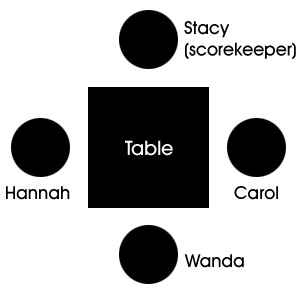
At every table, the scorekeepers pick up their dice and begin rolling. At the head table, Stacy, who is the scorekeeper for that table, rolls two 1's and one 3:


Since two 1's were rolled, she earns 2 points and continues rolling.


This time she rolled 4, 2, and 1. She earns one more point for rolling the 1 and then she rolls again.

This time she rolls two 6's and a 2. She didn't roll any 1's so Stacy stops rolling and passes the dice clockwise to Carol, the next player.
Stacy is the scorekeeper, and since she earned 3 points during her turn, she puts a 3 in the "Us" column on her table tally.
Carol rolls the dice. She rolls a 2, a 1, and a 6:
A single 1 is rolled so Carol earns 1 point and rolls again.

She rolls 5, 4, and 1. Again she rolls a single 1 so she earns 1 more point and continues rolling.
This time she rolls a 3, 4, and 5. Since Carol didn't roll any 1's this time, she earns no points and she passes the dice clockwise to the next player, Wanda.
Stacy, the scorekeeper, writes down Carol's score. Carol is not Stacy's partner (they are not sitting across from each other) so Stacy puts a 2 in the "Them" column of her table tally.
Wanda rolls the dice.
She rolls three 3's which is 3-of-a-kind! However, since it is currently round 1 and not round 3, it's a "mini Bunco" but not a Bunco. Wanda earns 5 points instead and continues rolling.
She rolls a 4, 5, and 2. Wanda rolls no 1's so she earns no further points and she passes the dice to the player on her left, Hannah.
Wanda is Stacy's partner, so Stacy writes down a 5 in the "Us" column of her table tally.
Hannah rolls the dice. She rolls three 1's:
A Bunco! She calls out "Bunco!" and, since she is sitting at the head table and has earned 21 points, she rings the bell to signal that the round is over.
However, players who are still rolling may continue rolling as long as they continue to earn points. (This includes Hannah, even though she is the one who rang the bell.) Players can continue to earn points and roll Buncos until they roll no points, then their round is over.
Since she just earned points and still has a chance of earning more, Hannah rolls again.
She rolls a 4 and two 3's so she earns no further points, her turn is over, and the round ends.
At the end of the first round, Stacy's table tally looks like this:
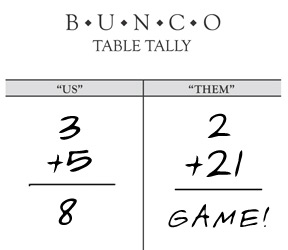
Stacy and Wanda earned a total of 8 points, and Carol and Hannah earned 23 points and win this round.
How to Play Bunco: Individual Player Scoring
Each player should have their own individual score card and keep track of their rounds on it.
- When a player wins a round, they should write a "W" on the line for that round.
- When a player loses a round, they should write an "L" on the line for that round.
- When a player rolls a Bunco, they should place a tally mark for each occurrence in the space marked "Buncos_______"
(NOTE: Only the player who rolled the Bunco will write down that they rolled a Bunco in that round. The player's partner will not!)
Some score cards have a space for tracking mini Buncos as well.
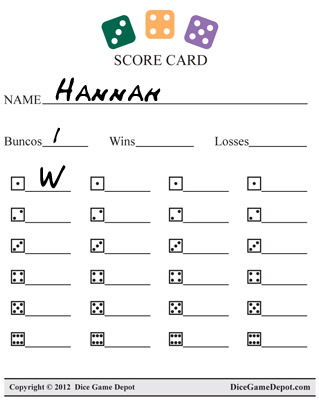
For example, in the game described above, each player on the winning team, Carol and Hannah, will record a "W" on the first " ________ " line on their scorecards. Since Hannah rolled a Bunco, she will also place a tally mark in the line provided.
Hannah's Bunco score card looks like this:
How to Play Bunco: Additional Rounds
At the beginning of each new round, all players should change seats and/or partners.
- The winning team at the head table (table #1) stays at the head table, but one of the players should move over a chair so they will have a different partner for the next round.
- The losing team from the head table should move to the middle table (table #2).
- The winning team from table #2 moves to the head table.
- The winning team from table #3 (sometimes humorously called the "Losing" table) moves to table #2.
- The losing team from table #2 goes to table #3.
- The losing team at table #3 stays at the table but one player should moves over a chair so they will have a different partner for the next round.
At the beginning of each round, someone at each table must volunteer to keep score.
Rounds 2 through 6 are played exactly as round 1 except that in each round points are awarded for the number of the dice that are the same as the number of that particular round. So for example, in round 2 the object is to roll  , and a Bunco will be .
Continue with each round until all the rounds are completed (or you decide to wrap things up).
How to Play Bunco: Finalizing Your Score
When all the rounds are completed, each player should count up all the occurrences of Wins ("W"), and Losses ("L") on their score sheet and then write the totals in the lines marked Wins_________ and Losses_________.
Tiebreakers During a Round
If both teams at a table have a tied score at the end of a round, they participate in a roll-off. Each player is allowed to roll the dice again for one session to accumulate additional points. The scorekeeper begins rolling first. This player will continue to roll and accumulate points as long as they are successfully rolling the number of that round. Each player is given a session to roll and accumulate points for their team to end the tie.
Example: at the end of round 2, a table's teams are tied. Player 1 rolls and accumulates 1 point. Player 1 rolls again but does not roll any dice. The dice are then passed to players 2, then 3, and then 4, all who receive chances to accumulate points.
If at the end of this session one team is now in the lead, the roll-off ends. The team with the highest score is deemed the winner.
If at the end of this first session the teams are still tied, additional roll-off session (s) are repeated until the tie is broken.
Optional Rule: Traveling
If you choose to add Traveling to your game, a soft fuzzy dice or small bean bag or other tossable object is used.
Traveling occurs whenever a specific set of numbers are rolled. The exact numbers that must be rolled are determined by the hostess or players and announced at the beginning of the game or round. For example, rolling in ANY round, or three-of-a-kind of any non-Bunco trio in ANY round (except round 5).
Then, when the specified trio of numbers are rolled, the player shouts out "TRAVELING!" and the bag or object is tossed to the lucky player. The player holds it until another player rolls Traveling.
The player holding the bag or object at the end of the game wins a prize!
Optional Rule: Prize Categories
The hostess may choose to create award categories and offer prizes to the players. Here are some suggestions:
- Most Buncos
- Most mini Buncos
- Most Wins
- Half Wins and Half Losses (Player with an even split of wins and losses)
- Last Bunco
- Most Losses
- Traveling (Last person holding the traveling item)
Visit our Bunco Questions page for more details on Bunco parties!
